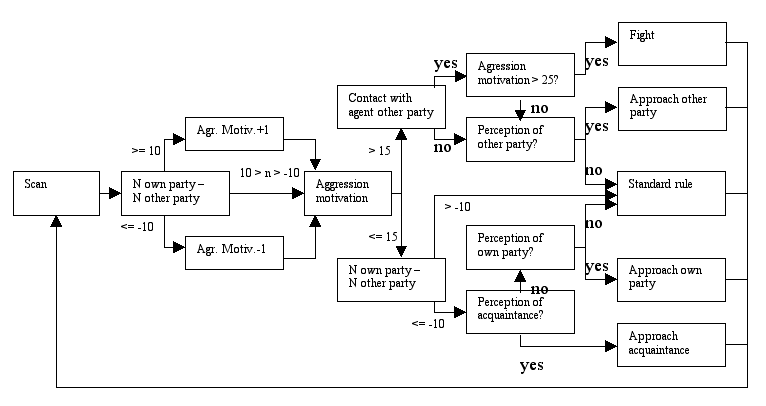
Most of the thresholds are indeed taken directly from the model of Jager and colleagues (which is illustrated in the original sketch above). The only change here was that I reduced the "Aggression motivation" (which is "security" in my terms, since it relates only to the ratios of block members in the vicinity) necessary to engage in a fight from 25 (out of 30) to 20 (out of 30), because I already included the additional "hurdle" of needing a fairly high aggression level (again, my term; also set to 20) for that.
The general idea behind that:
Jager, Popping, and van de Sande were mainly interested in the clustering aspect of rioting (which is handled by these thresholds, and which is pretty much preserved here); but what I did here was to further differentiate the conditions that have to be met for the actual "switch" from non-violent to violent behavior. For that, I "split" their single 0-30 "aggression motivation" variable into two, namely a more context-based one, "security", and one that is more affected by the "traits" of individual agents, "aggression level". In Jager's model, the agents lack any such individual traits, and they are instead arbitrarily grouped into three "types" with varying scanning frequencies (scan once every 10, 20, and 80 ticks) as the sole distinctive feature, whereas my agents all operate on the same scanning frequency (10 as it is). Now I hope to still find the same basic categories of agents (hardcore, hanger-on, bystanders) by merely looking at the "insecurity", "leadership" (or status/power, as we discussed), and "aggression tendency" values.

No comments:
Post a Comment